How Nonprofits Are Using AI to Write Grants Faster
Grant writing is the bottleneck nobody talks about
If you run a nonprofit, you already know the math: you need grants to fund programs, but writing grants takes so long that it pulls you away from running those programs. Most small and mid-sized nonprofits don't have a dedicated grant writer. The executive director or development director is drafting proposals between meetings, site visits, and board prep.
AI doesn't write your grants for you. But it cuts the drafting time in half — and for a sector where time is the scarcest resource, that changes everything.
What AI can and can't do for grant writing
AI is good at:
- Drafting narrative sections from your bullet points
- Reformatting existing language for different funders
- Generating needs statements from data you provide
- Summarizing program outcomes into funder-friendly language
- Proofreading and tightening your final draft
AI is not good at:
- Inventing program data or outcomes (don't let it)
- Understanding your specific funder relationship
- Replacing your organization's authentic voice
- Making strategic decisions about which grants to pursue
The best approach: you provide the substance, AI provides the structure and polish.
A practical AI workflow for grant proposals
Step 1: Build your master content bank
Before you write a single proposal, dump everything the AI needs into a document: your mission statement, program descriptions, key outcomes data, organizational history, leadership bios, and budget narratives. This is your reusable base.
Do this once. Update it quarterly. Every grant proposal you write from here forward starts from this foundation.
Step 2: Draft the needs statement
The needs statement is often the hardest section to start. Give the AI your community data and ask it to write a compelling narrative.
"Write a needs statement for a grant proposal. Our organization serves [population] in [location]. The key issue is [problem]. Supporting data: [statistics]. Write it in a way that conveys urgency without being exploitative. Keep it under 300 words."
You'll get a strong first draft in seconds. Edit it for accuracy, tone, and your organization's voice.
Step 3: Adapt for each funder
Most grant proposals share 70% of the same content. The other 30% is tailored to the specific funder's priorities, language, and requirements. AI handles this adaptation quickly.
"Here's our standard program description: [paste text]. Rewrite it to align with this funder's priorities: [paste funder guidelines or focus areas]. Match their language and emphasis while keeping our key points intact."
What used to take two hours of careful rewriting now takes fifteen minutes of review and editing.
Step 4: Tighten the final draft
AI is an excellent editor. Before you submit, run your draft through one more pass.
"Review this grant proposal section for clarity, conciseness, and persuasiveness. Cut unnecessary words. Strengthen weak sentences. Flag any claims that aren't supported by specific data."
Real talk: the ethics of AI in grant writing
Funders are aware that nonprofits are using AI. Some have explicit policies. Most don't — yet. Here's the responsible approach:
- Never fabricate data. If AI generates a statistic you didn't provide, delete it. Check every number.
- Keep your voice. AI drafts are a starting point. The final submission should sound like your organization, not like a chatbot.
- Be transparent if asked. If a funder asks whether you used AI, be honest. "We used AI tools to help draft and edit, but all data and program details are our own."
- Review everything. No grant proposal should go out without a human read-through. AI makes mistakes. It hallucinates. It misses context. You're the quality control.
The bigger picture: AI across nonprofit operations
Grant writing is just the entry point. The same AI tools that help you draft proposals can also:
- Write donor thank-you letters and campaign emails
- Generate board reports and impact summaries
- Create social media content from your program updates
- Summarize meeting notes and action items
- Draft volunteer recruitment materials
Every hour AI saves you on administration is an hour you can spend on mission.
Go deeper
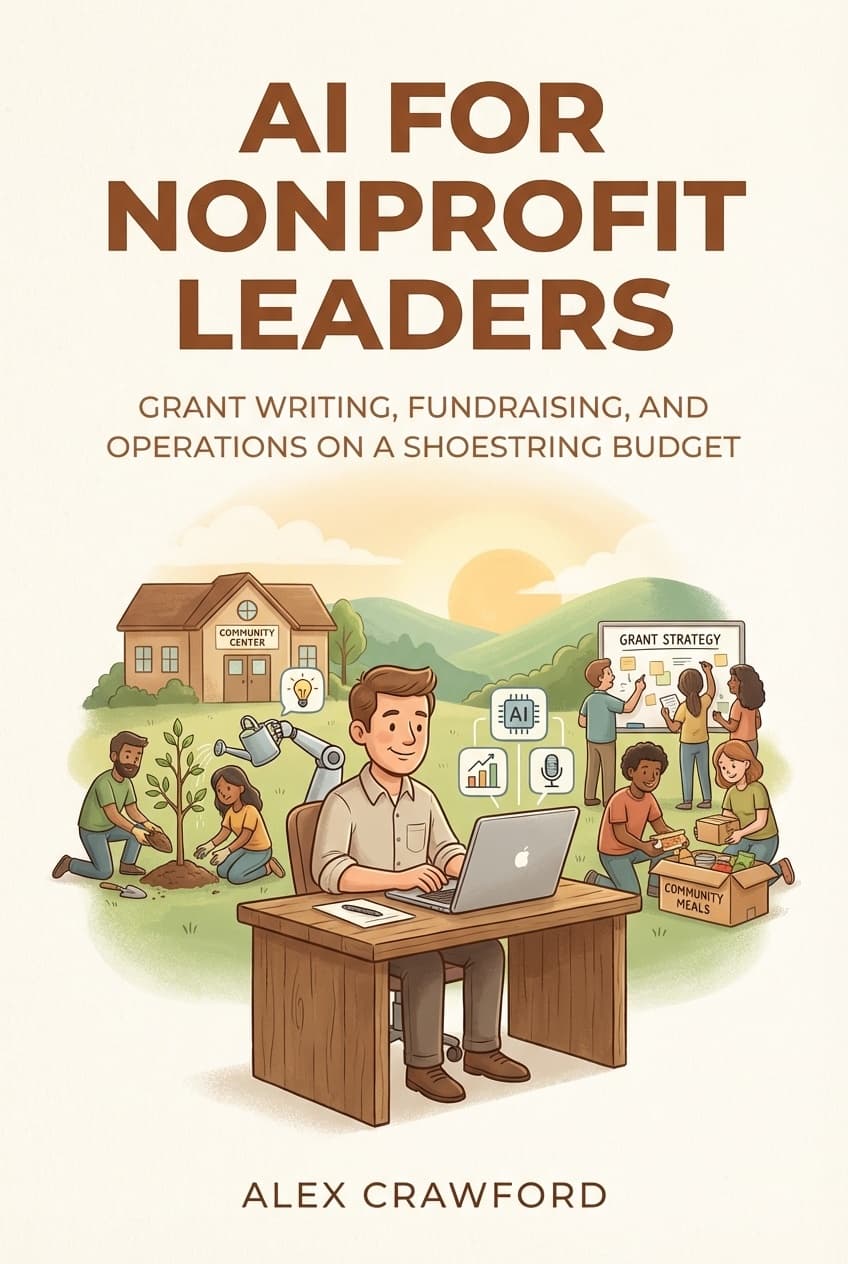
For a complete system covering grant writing, donor communications, board reporting, volunteer management, and impact measurement — all built for nonprofits with no tech budget — check out AI for Nonprofit Leaders: Grant Writing, Fundraising, and Operations on a Shoestring Budget.