How to Use AI to Write Donor Communications That Actually Get Read
Your donors aren't ignoring you — they're ignoring your emails
The average donor receives appeals from a dozen organizations. Most of those emails sound identical: vague impact claims, stock-photo attachments, and the same "Your gift makes a difference" language that stopped landing years ago.
The nonprofits that retain donors year after year do one thing differently: they communicate like humans. Their updates tell specific stories. Their thank-yous reference specific gifts. Their appeals connect specific dollar amounts to specific outcomes.
The problem isn't that nonprofit teams don't know how to write well — it's that they don't have time. When you're managing programs, tracking grants, and reporting to the board, donor communications get pushed to Friday afternoon. And Friday-afternoon writing rarely inspires generosity.
AI changes the math. Not by replacing your voice, but by giving you a first draft that's 80% there in 5 minutes instead of an hour.
Year-end appeal letters that don't sound like every other one
Year-end is when 30% of all charitable giving happens. Your appeal letter competes with a stack of others. The ones that stand out are specific, emotional, and honest.
"Write a year-end fundraising appeal for a nonprofit called [name] that works on [mission]. This year's key accomplishment: [specific achievement — '147 families housed' is better than 'we helped many families']. Include a specific story — use this real scenario as the basis: [brief description of a beneficiary story, anonymized]. Connect a specific donation amount to a specific outcome ($50 = one month of [service]). Keep it under 400 words. Tone should be urgent but not guilt-inducing."
Review and revise the output. The AI won't know your voice perfectly on the first try, but it will give you structure, flow, and a draft that's faster to edit than to write from scratch.
Time saved: Annual appeal letter goes from an agonizing 2-day process to a 2-hour refine-and-polish session.
Monthly donor updates that build loyalty
Retention is cheaper than acquisition, and the number-one reason donors stop giving is that they feel like their gift disappeared into a void. A monthly or quarterly update fixes that.
"Write a short monthly donor update email for [nonprofit name]. This month's highlights: [list 2-3 specific things that happened — events, milestones, new programs, impact numbers]. Include one brief human story. End with a look ahead at what's coming next month. Don't ask for money in this email — this is purely a relationship-building update. Keep it under 250 words. Warm, conversational tone."
The discipline of sending regular updates without always asking for money is the single best thing you can do for donor retention. AI makes it feasible by eliminating the blank-page problem each month.
Thank-you messages that feel personal at scale
A generic "Dear Donor, Thank you for your generous contribution" email does more harm than good. It tells the donor they're just a record in a database. A personalized thank-you — even a short one — tells them they matter.
"Write 5 variations of a thank-you email for a [donation amount range] gift to [nonprofit name]. Each should: reference the specific impact their gift enables, express genuine gratitude without being over-the-top, and include one sentence about what's coming next for the organization. Keep each under 100 words. Make them sound like a real person wrote them, not a template."
Create a library of these, segmented by gift level and program area. When a donation comes in, grab the right template, add the donor's name and any personal details, and send. Personalized in substance, efficient in practice.
Board reports and impact summaries
Board members and major donors want data, but they also want narrative. A page of numbers without context doesn't tell the story of your impact.
"Here's our quarterly program data: [paste metrics — people served, programs delivered, outcomes achieved, budget figures]. Write a one-page impact summary for our board of directors. Lead with the most compelling outcome. Use the data to tell a story, not just report numbers. Include one challenge we're facing and how we're addressing it. Keep it professional but not dry."
This same format works for major donor stewardship reports. Swap the audience from "board" to "major donors" in the prompt and adjust the tone slightly.
Time saved: Quarterly board impact report drops from a full day to about 90 minutes.
Segmented appeals for different donor groups
A first-time donor and a ten-year supporter should not receive the same appeal. They have different relationships with your organization and different motivations for giving.
"Write three versions of a spring fundraising appeal for [nonprofit name]: (1) For first-time donors who gave once last year — focus on welcoming them into the community and showing the impact of their first gift. (2) For recurring donors of 3+ years — focus on their loyalty, cumulative impact, and invite them to deepen involvement. (3) For lapsed donors who haven't given in 18+ months — acknowledge the gap without guilt, share what's new, and make a gentle ask. Each version should be under 250 words."
This kind of segmentation dramatically improves response rates, but most nonprofits don't do it because writing three versions of every appeal triples the work. AI eliminates that bottleneck.
Grant language repurposed for donor communications
You've already done the hard work of articulating your programs and impact for grant applications. That language can be adapted for donor-facing communications.
"Here's a section from a recent grant proposal for our [program name] program: [paste grant language]. Rewrite this for a general donor audience. Remove jargon and technical language. Make it emotionally resonant while keeping the facts accurate. The goal is to make a donor feel excited about supporting this program. Under 200 words."
This is one of the highest-leverage uses of AI for nonprofits — you've already written the substance, and AI helps you translate it for a different audience.
The voice question
Nonprofit leaders worry that AI-written communications will sound generic or inauthentic. That's a valid concern — and the solution is simple. Use AI for the first draft, then edit in your voice. Add the specific detail about the mom who cried at graduation. Reference the inside joke from the volunteer appreciation dinner. Mention the rainstorm that almost cancelled the event but didn't.
AI handles structure and flow. You handle the moments that make your organization irreplaceable.
Go deeper
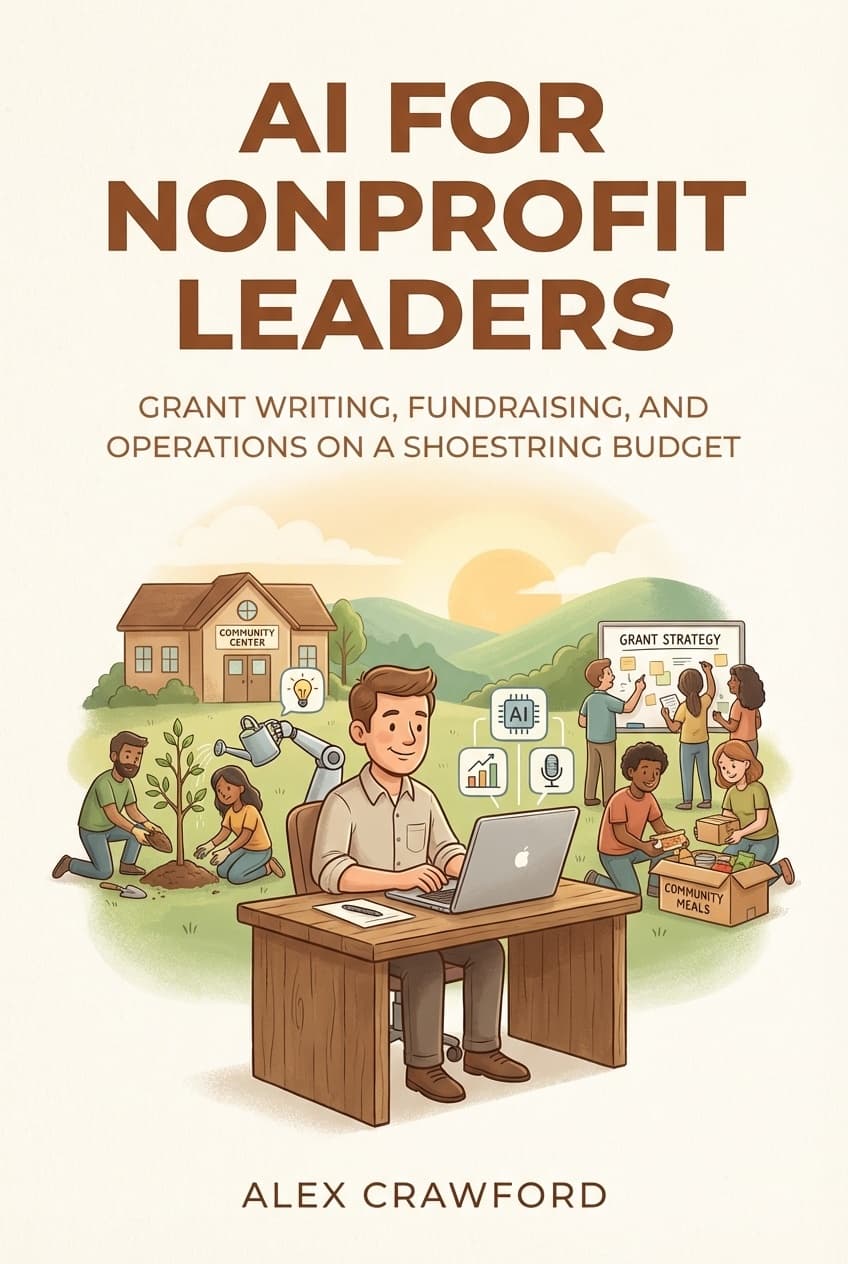
For complete AI workflows covering grant writing, donor communications, program management, board reporting, and operations — all designed for teams with zero tech budget — check out AI for Nonprofit Leaders: Grant Writing, Fundraising, and Operations on a Shoestring Budget. Fourteen chapters of practical tools for doing more with less.