Chapter 1. The Contracts You’re Losing While You Wait
Overview
- Purpose: Why legacy businesses must act now. The competitive threat from AI-native and AI-adopting rivals. What actually happens to companies that wait – told through real losses, not hypotheticals. Why “we’re different” is the most dangerous phrase in business.
- You will learn: How AI-adopting competitors are winning business from traditional companies right now, the real financial cost of waiting, why legacy businesses are more vulnerable than they think, and how to calculate your own cost of inaction.
- Tools needed: Access to your company’s recent lost bids or customer attrition data, a calculator
- Time to implement: 30 minutes to complete the cost-of-inaction exercise
The Story: “The RFP That Changed Everything”
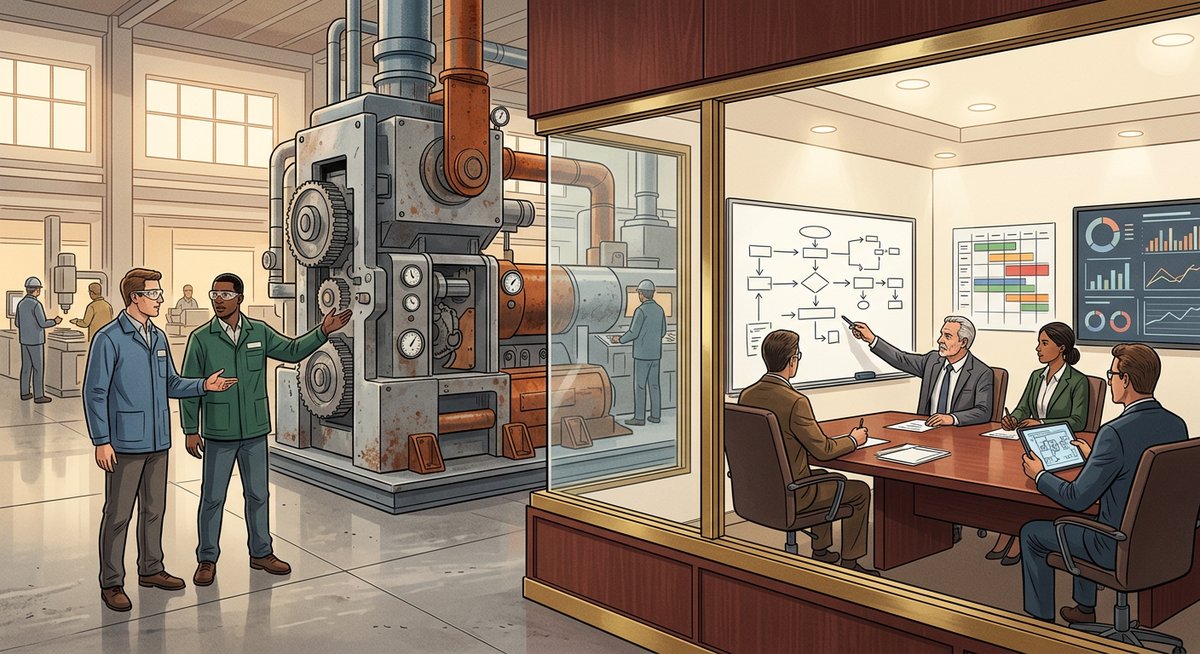
Ray Hutchinson spread the RFP response across his desk in the glass-walled office overlooking the shop floor and read it for the third time. Precision Components International – a company half the size of Hutchinson & Sons five years ago – had won the Meridian Aerospace contract. The contract Ray’s father had held for eleven years. The contract that represented 14% of annual revenue.
The letter from Meridian’s procurement director was polite, professional, and devastating. “After careful evaluation, we have selected a supplier who can meet our revised lead-time requirements of 72-hour turnaround on standard orders and provide real-time production visibility through a digital dashboard.” Ray stared at the phrase “real-time production visibility.” His shop floor ran on a mix of 1990s CNC controllers and newer machines that could be networked but were not. His scheduling happened in a spreadsheet his production manager updated twice a day. His quoting process took three days because his estimator had to walk the floor and check machine availability in person.
He picked up the phone and called Linda Vasquez. Linda ran Vasquez Industrial Supply, the distributor that had supplied raw materials to Hutchinson & Sons for two decades. Their families had done business together since before Ray was born. “Linda, we lost Meridian,” he said. There was a pause. “We lost them too,” she replied. “Their new supplier uses an AI system that auto-generates purchase orders based on production schedules. They told us our three-day quoting cycle doesn’t work for them anymore.”
Ray leaned back in his chair and looked through the window at the shop floor. His most experienced machinist, Carl, was hand-adjusting a setup on the Okuma lathe – the same way he had done it for thirty-two years. Carl was the best in the business. He could hear a bearing going bad before any sensor could detect it. But Carl could not give Meridian a digital dashboard. He could not promise 72-hour turnaround optimized by an algorithm. He could not compete with a company that had spent the last two years connecting its machines, training its systems, and learning how to deliver what customers now expected.
This was the second major contract Ray had lost in eight months. The first, a defense subcontractor, had switched to a competitor who promised AI-optimized scheduling and predictive quality data. Together, the two lost contracts represented $6.2 million in annual revenue – nearly 15% of the business his family had spent sixty years building. And for the first time in his career, Ray Hutchinson was not sure he could win them back.
The Competitive Reality You Cannot Ignore
If you are a leader at a traditional business – a manufacturer, a utility, a construction company, an industrial distributor – you have probably heard some version of the same reassurance from your peers: “AI is for tech companies. We’re different. Our customers value relationships. Our people are our competitive advantage.”
Every one of those statements contains a grain of truth. And every one of them is becoming more dangerous by the quarter.
Here is the reality in 2026. Global AI spending has reached $2.52 trillion, up from $900 billion just two years ago. That number is not being driven by Silicon Valley startups alone. It is being driven by your competitors – the ones you have not been watching closely enough. According to McKinsey’s State of AI report, 88% of organizations now report regular AI use in at least one business function, up from 55% just two years prior. The gap between companies that have adopted AI and those that have not is widening every quarter, and the consequences are showing up where it hurts most: in lost contracts, lost customers, and lost talent.
What AI-Adopting Competitors Are Actually Doing
This is not theoretical. Here is what companies in traditional industries are deploying right now:
| Industry | AI Application | Competitive Advantage Gained |
|---|---|---|
| Contract Manufacturing | AI-optimized scheduling | 10-30% throughput improvement, faster quotes |
| Industrial Distribution | AI-powered demand forecasting | 15-30% reduction in inventory costs, faster fulfillment |
| Utilities | Predictive maintenance | 25-30% lower maintenance costs, 50% less unplanned downtime |
| Construction | AI estimating and scheduling | Projects completed up to 30% faster |
| Agriculture | Precision application (See & Spray) | Up to 90% reduction in chemical inputs |
These are not pilot programs at Fortune 500 companies. These are production deployments at mid-market firms – companies with 200 to 2,000 employees, with revenues between $50 million and $500 million. Companies that look like yours.
The Speed of Change Is Accelerating
Two years ago, most traditional industry leaders could afford to watch and wait. That window is closing. Consider the trajectory:
- In construction, AI adoption grew 59% year-over-year in 2024 despite starting from a low base. The global AI-in-construction market is projected to grow from $4.8 billion in 2025 to $22.6 billion by 2032.
- In manufacturing, 77% of companies now report utilizing AI solutions in some capacity. Deloitte predicts a fourfold increase in agentic AI adoption in manufacturing – from 6% to 24% – in 2026 alone.
- Even among family-owned enterprises, 42% now list increasing AI use as a top strategic priority.
The companies adopting AI today are not doing it because it is trendy. They are doing it because their customers are demanding capabilities that manual processes cannot deliver: real-time visibility, faster turnaround, predictive quality assurance, and data-driven decision-making.
Why “We’re Different” Is the Most Dangerous Phrase in Business
Every industry has told itself this story. Bookstores were different – until Amazon. Taxi companies were different – until Uber and Lyft. Travel agencies were different – until Expedia and Booking.com. The pattern is always the same: incumbents dismiss a new capability as irrelevant to their industry, right up until the moment it takes their customers.
The legacy business version of this story sounds like this:
“Our customers value relationships.” They do. But when a competitor can match your relationship quality AND provide a digital dashboard, real-time tracking, and 40% faster turnaround, the relationship alone stops being enough. Relationships get you the meeting. Capability gets you the contract.
“Our people are our competitive advantage.” Your experienced workforce IS a genuine asset. But when your best estimator takes three days to do what a competitor’s AI system does in three hours, your people advantage becomes a speed disadvantage. The question is not whether your people are skilled – it is whether you are giving them the tools to compete.
“AI doesn’t work in our industry.” The data says otherwise. Predictive maintenance alone is delivering 25-30% cost reductions across manufacturing, utilities, and mining. Visual quality inspection AI is detecting defects that experienced inspectors miss. AI-optimized scheduling is reducing lead times by double digits. It is working. Just not at your company. Yet.
“We don’t have the data for AI.” This one is partially true – 98% of manufacturers struggle with their data. But it is a solvable problem, not a permanent condition. Your competitors who started their data journey 18 months ago are now deploying AI on top of it. Every month you delay starting is another month they pull ahead.
The Real Cost of Waiting
The cost of inaction is not an abstract concept. It shows up in specific, measurable ways:
Lost Revenue
Ray Hutchinson lost $6.2 million in annual contracts to AI-adopting competitors. That revenue loss is permanent until he can match their capabilities – which will take 12-18 months of data preparation and technology deployment even if he starts today. Every month of delay extends that gap.
Talent Drain
The best employees at traditional companies are watching. When they see leadership ignore AI, they draw conclusions about the company’s future. A 2026 survey by JRG Partners found that a critical leadership skill gap is widening for executives fluent in AI and analytics. The mid-career engineers and managers you need to lead your company forward are increasingly choosing employers who are investing in modern capabilities.
Margin Compression
Competitors using AI to optimize operations are lowering their cost structures. A manufacturer using predictive maintenance spends 25-30% less on maintenance than one using reactive methods. That cost advantage flows directly to the bottom line, allowing them to bid more aggressively while maintaining margins. You are competing against a lower cost structure, and the gap widens every year.
Customer Expectations
Once a customer experiences AI-enabled service from one supplier – real-time order tracking, predictive delivery estimates, digital quality documentation – they start expecting it from every supplier. The bar does not lower. Your largest customer may not have mentioned AI yet, but their procurement team is benchmarking you against suppliers who offer it.
The Numbers That Should Keep You Awake
| Metric | Number | What It Means for You |
|---|---|---|
| AI project ROI (per dollar invested) | 3.7x | Your competitors are getting nearly 4x return on their AI investments |
| Unplanned downtime cost per hour | $260,000 | Every hour of downtime your competitors prevent with AI is money you are still spending |
| Lead time reduction from AI scheduling | 10-30% | Competitors are promising faster delivery with the same equipment |
| Predictive maintenance cost reduction | 25-30% | Your competitors’ maintenance budgets are shrinking while yours stays flat |
| Mid-market PdM pilot annual savings | $200K-$500K | A single pilot project could save a quarter to a half million dollars a year |
What Actually Happens to Companies That Wait
The research is clear on what happens to traditional businesses that delay AI adoption. Harvard Business Review reported in early 2026 that incumbent companies are deploying AI widely but losing out to smaller, more agile challengers. The problem is not that incumbents refuse to adopt AI – most eventually do. The problem is that they adopt it too late to maintain their competitive position.
The pattern unfolds in predictable stages:
Stage 1: Dismissal (Year 0-1). Leadership hears about AI but considers it irrelevant. “We are a manufacturing company, not a tech company.” Competitors begin investing in data infrastructure.
Stage 2: Awareness (Year 1-2). A lost contract or customer complaint forces the issue. Leadership begins researching AI but takes no concrete action. Competitors launch pilots and begin generating returns.
Stage 3: Panic (Year 2-3). Multiple lost contracts and margin pressure create urgency. Leadership demands an AI strategy in 90 days. But the data foundation that takes 12-18 months to build does not exist. Competitors are scaling from pilots to production.
Stage 4: Expensive Catch-Up (Year 3-4). The company spends significantly more than early movers to build data infrastructure and deploy AI under competitive pressure. Talent is harder to find because the best candidates chose companies that started earlier. Competitors are on their second and third AI use cases.
The cost differential is stark. Companies that start AI adoption proactively spend less and see returns faster than those who start under competitive pressure. The vendor you negotiate with calmly from a position of strategic planning gives you a better deal than the vendor you negotiate with desperately because you are losing contracts.
The Advantage You Already Have (And Don’t Realize)
Here is the counterintuitive truth that most AI discussions miss: mid-market legacy businesses actually have structural advantages in AI adoption that large enterprises do not.
You can move faster. A plant manager at a 200-person manufacturer can approve a $150,000 pilot in a week. A VP at a Fortune 500 company needs six months of internal approvals, architecture reviews, and stakeholder alignment. A 2026 analysis found that midsized Tier 2 and Tier 3 firms actually report quicker ROI realization on AI projects compared to larger enterprises, precisely because they lack the layers of governance that slow enterprise adoption.
Your problems are concrete. You do not need AI to “transform the customer experience” or “reimagine the value chain.” You need to reduce unplanned downtime on the CNC mill that keeps breaking. You need to quote jobs faster than the three days it currently takes. You need to predict when the delivery truck needs maintenance before it breaks down on the highway. These are specific, measurable problems with specific, measurable solutions.
Your people know the domain. The machinist with 30 years of experience, the dispatcher who knows every route, the maintenance technician who can hear a bearing going bad – these people have domain expertise that AI companies would pay millions to acquire. The challenge is not replacing their knowledge. It is augmenting it with tools that let them do more with what they already know.
Your data is more valuable than you think. Yes, it is messy. Yes, it lives in spreadsheets and filing cabinets and the heads of experienced employees. But it is YOUR data – decades of operational history that no competitor has. Once it is cleaned and connected, it becomes the foundation for AI models that are uniquely tailored to your operation.
The 80% Failure Rate – And Why You Should Not Let It Stop You
You may have seen the statistic: 80% of AI projects fail. It is real. And it deserves context.
The companies that fail at AI share a set of common characteristics: they start with the technology instead of the problem, they skip data preparation, they underestimate change management, they try to transform everything at once, and they treat AI like an IT project rather than a business initiative.
This book exists to help you avoid every one of those mistakes. The 80% failure rate is not a law of nature. It is a consequence of poor strategy, unrealistic expectations, and the absence of the kind of practical, legacy-business-specific guidance that has not existed until now.
The companies that succeed at AI in traditional industries share their own set of characteristics: they start with a specific, costly problem. They invest in data foundations before they invest in algorithms. They bring their workforce along instead of imposing technology from above. They define success in terms the CFO understands. And they start small – boring, even – with pilot projects that prove value before they scale.
That is the approach this book will teach you.
Try This Now (15 Minutes)
Calculate your company’s cost of inaction using this simple framework:
Step 1: Lost or at-risk revenue. List every contract you have lost in the past 24 months where the competitor offered technology capabilities you could not match. List every current customer who has asked about digital dashboards, real-time tracking, or faster turnaround. Estimate the annual revenue at risk.
Step 2: Downtime costs. Calculate your average cost of unplanned downtime per hour (include lost production, emergency repair labor, expedited parts, missed delivery penalties). Multiply by the number of unplanned downtime hours in the past 12 months. If predictive maintenance could reduce that by 25%, what would you save?
Step 3: Quoting and scheduling inefficiency. How many hours per week does your team spend on manual quoting, scheduling, or production planning? Multiply by average loaded labor cost. If AI could reduce that time by 30%, what would you save annually?
Add the three numbers together. That is the annual cost of standing still. Write it down. You will need it when you build your business case in Chapter 3.
Key Takeaways
- AI-adopting competitors are winning contracts, reducing costs, and raising customer expectations in every traditional industry – manufacturing, utilities, construction, distribution, and agriculture. The competitive threat is not theoretical; it is happening now, and every quarter of delay widens the gap.
- Mid-market legacy businesses have structural advantages in AI adoption that large enterprises lack – faster decision-making, concrete problems to solve, deep domain expertise, and decades of proprietary operational data. The challenge is not capability; it is starting.
- The 80% AI project failure rate is a consequence of poor strategy, not a reflection of the technology itself. Companies that start with specific business problems, invest in data foundations, and bring their workforce along succeed at rates that make the investment compelling.
This Week’s Action Items
Next Up
In Chapter 2, we will stop talking about the threat and start assessing where you actually stand. You will complete an honest organizational readiness assessment – scoring your data, people, processes, culture, and infrastructure through an AI lens for the first time. Most legacy businesses land in the same place on the maturity model, and knowing where you are is the first step to knowing where to go.