Chapter 1. Welcome to Legacy IT – Why Nobody Wrote This Book for You
Overview
- Purpose: What makes IT management at traditional businesses fundamentally different from tech companies. The five archetypes of legacy business IT environments. Why generic IT management advice fails when your ERP is older than your newest hire.
- You will learn: Why legacy business IT is a distinct discipline, the five archetypes of legacy IT environments, the real challenges that generic IT management books ignore, and how to identify which archetype matches your organization.
- Tools needed: No tools required – just honest self-reflection about your current environment
- Time to implement: 30 minutes to read and complete the self-assessment exercise
The Story: “The System Nobody Can Explain”
Maria Vasquez was 42 minutes into what was supposed to be a 15-minute production meeting when the plant manager at Precision Auto Components’ Dayton facility asked the question she had been dreading for three years.
“Maria, why can’t we just get real-time production numbers on the dashboard like the guys at Delphi showed us at the trade show last month?”
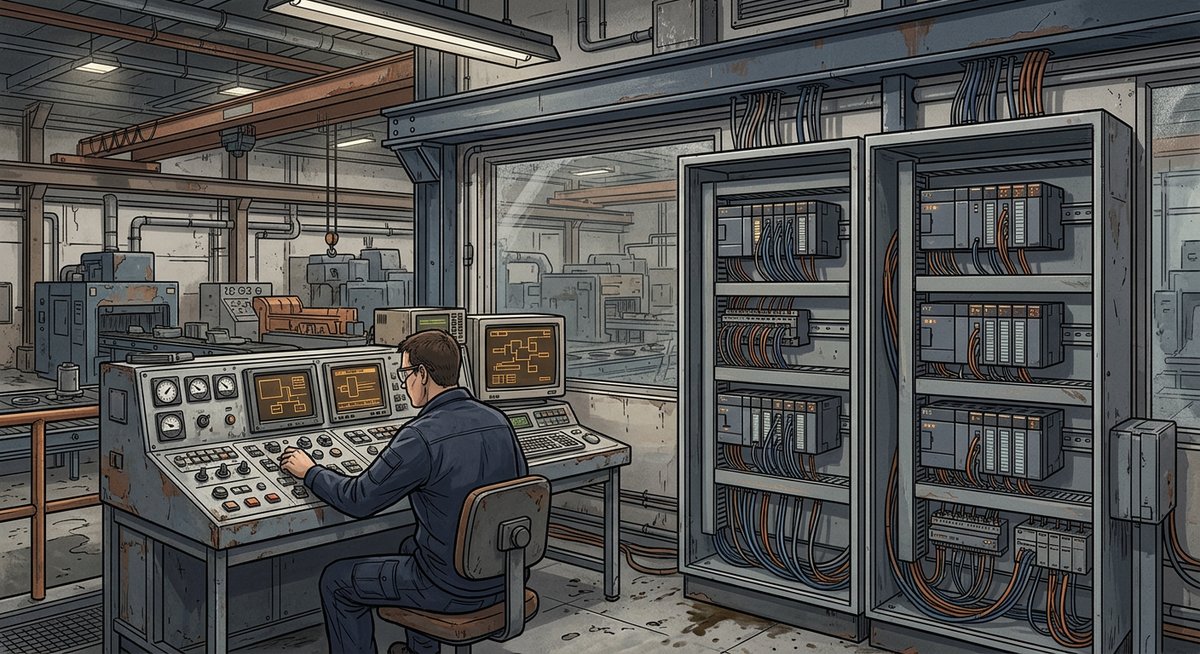
She took a breath. The honest answer was complicated. Their production data lived inside an AS/400 that had been running the company’s core ERP since 2001. The RPG programs that tracked work orders, inventory, and shipping had been written by a contractor named Gene Dietrich, who retired in 2019 and moved to a cabin in West Virginia with spotty cell service. Gene had documented roughly 30 percent of what he built. The other 70 percent – the batch jobs that reconciled inventory at 2 AM, the custom flags that triggered reorder points for their Japanese OEM customers, the logic that calculated scrap rates differently for their stamping operation versus their machining operation – existed only in the code and in Gene’s head.
The AS/400 talked to the plant floor through a middleware layer that a different contractor had built in 2014 using a combination of Python scripts and flat-file exports. Every 15 minutes, a scheduled task on a Windows Server 2012 R2 box pulled production counts from the Allen-Bradley ControlLogix PLCs on the stamping line, wrote them to a CSV file on a network share, and a second script on the AS/400 picked up that file and updated the production tracking database. When it worked, it was invisible. When it broke – which happened roughly once a month – Maria’s team spent anywhere from two hours to two days figuring out which piece of the chain had failed.
“We can work toward that,” Maria said carefully. “But the system that holds our production data was not designed to serve real-time dashboards. Getting there means either building an API layer on top of the existing system or replacing pieces of it. Either way, we are talking about a project, not a setting I can toggle.”
The plant manager nodded, but she could see the skepticism. In his mind, technology was technology. His phone could show him the weather in real time. Why couldn’t the million-dollar system in the server room show him how many parts they stamped today?
After the meeting, Maria walked back to her office – a converted storage room next to the server closet on the second floor of Building A – and sat down at her desk. She had four people on her team, including herself. One handled helpdesk and desktop support across three plants. One managed the network and the servers. One split time between the AS/400 and the accounting system. Maria handled everything else: security, compliance, vendor management, budgets, strategy, and the growing stack of projects that leadership wanted done yesterday.
She pulled up her browser and searched for “IT management best practices” for the third time that year. The results were the same: articles about agile transformation, DevOps pipelines, cloud-native architecture, and digital-first strategies written by people who had never seen an AS/400, never explained to a plant manager why a firewall upgrade matters, and never tried to recruit a systems administrator to Dayton, Ohio.
Nobody had written a book for her.
Until now.
The IT Manager Nobody Talks About
There are roughly 667,000 computer and information systems managers in the United States. The technology press, the conference circuit, and the management book industry treat them as a monolith – as though the VP of Engineering at a San Francisco SaaS company and the IT director at a 200-person auto parts manufacturer in Ohio face the same challenges, use the same tools, and need the same advice.
They do not.
If you are reading this book, you probably work at a company where IT is not the product. Your employer makes things, builds things, generates power, treats water, processes permits, or provides services that have nothing to do with software. Technology supports the business. It is not the business.
This distinction changes everything about how you do your job.
At a tech company, the CTO has a seat at the executive table. The engineering budget is the largest line item. Developers outnumber everyone else. The entire organization understands, at some level, what technology does and why it matters.
At your company, the IT budget is 2 percent of revenue – maybe 3 percent in a good year. Your team is four people, or three, or just you. The CEO built the business on relationships and operational excellence, not technology. When you ask for money to replace a server, you are competing against a new CNC machine, a warehouse expansion, or a fleet of trucks. And you lose that competition more often than you win.
This is not a complaint. It is a different discipline. And it requires a different playbook.
Why Generic IT Management Advice Fails Here
Pick up any mainstream IT management book published in the last decade. You will find advice like:
- “Build a DevOps culture with continuous integration and deployment.”
- “Adopt a cloud-first strategy for all new workloads.”
- “Implement agile methodologies across your development teams.”
- “Hire specialists for each domain – security, networking, cloud, data.”
None of this is wrong. All of it is irrelevant to your situation.
You do not have development teams. You do not deploy code. Your most critical system is a 25-year-old ERP that you cannot move to the cloud because the vendor went out of business in 2012. You cannot hire specialists because your entire team is three people and your budget does not support a single six-figure salary, let alone four.
The gap between mainstream IT management literature and the reality of legacy business IT is not a minor mismatch. It is a chasm. And it leaves tens of thousands of capable, hardworking IT professionals without a guide that speaks to their actual challenges.
Here is what makes your world different:
| Factor | Tech Company | Legacy Business |
|---|---|---|
| IT budget as % of revenue | 8-19% | 1.4-3.2% |
| Team size | Dozens to hundreds | 1-5 people |
| Oldest system in production | 2-3 years | 15-30 years |
| Leadership’s view of IT | Revenue driver | Cost center |
| Hiring pool | Global, remote-first | Local, on-site required |
| Change velocity | Deploy daily | Change quarterly (maybe) |
| Primary risk | Moving too slow | Breaking what works |
| Compliance burden | SOC 2, maybe | NERC CIP, CMMC, SOX, HIPAA |
This book was written for the right side of that table.
The Five Archetypes of Legacy Business IT
After 15 years of working in and consulting with traditional businesses, I have identified five distinct archetypes of legacy IT environments. Most organizations are a blend of two or three, but understanding the archetypes helps you diagnose your situation and apply the right strategies.
Archetype 1: The Inherited Empire
Profile: A single monolithic system – usually an ERP – runs everything. It was installed 15-25 years ago, heavily customized by consultants or a now-departed internal developer, and has become the gravitational center of the entire business. Every process flows through it. Every report depends on it. The people who understand it are retiring or already gone.
Common platforms: IBM AS/400 (IBM i) with custom RPG programs, older versions of Epicor, SYSPRO, or Sage on Progress OpenEdge, SAP ECC that predates S/4HANA.
Defining characteristic: The system works – and that is both the blessing and the curse. Leadership sees no reason to change something that works. But the risk compounds silently: the knowledge to maintain it is vanishing, the security posture is deteriorating, and the cost of eventual replacement grows every year.
Maria’s world at Precision Auto Components is a textbook Inherited Empire. The AS/400 has been the beating heart of the business for a quarter century. It works reliably. It does what the business needs. But the number of people who understand it shrinks every year, and the day is coming when “it works” will become “it worked.”
Archetype 2: The Patchwork Quilt
Profile: No single system dominates. Instead, the technology landscape is a collection of standalone applications, spreadsheets, personal databases, and departmental tools stitched together with manual processes, flat-file exports, and heroic workarounds. Shadow IT is rampant because the official tools never met department needs.
Common elements: QuickBooks for accounting, Excel spreadsheets as databases, Access databases that someone built in 2008, personal Dropbox accounts holding company data, a dozen SaaS tools that departments adopted on their own.
Defining characteristic: Nothing is integrated. Data lives in silos. The same customer information exists in four different systems with four different spellings. The IT manager spends most of their time putting out fires caused by the gaps between systems rather than building anything strategic.
Jim’s situation at Halvorsen-Mueller Construction is pure Patchwork Quilt. Project managers use whatever apps they want. Estimating lives in one system, accounting in another, and project documents on personal cloud storage accounts that nobody in IT controls.
Archetype 3: The Regulated Fortress
Profile: The IT environment is shaped primarily by compliance requirements rather than business strategy. Regulations dictate which systems must be maintained, how data must be stored, what controls must be documented, and how changes must be approved. The IT manager spends as much time on compliance documentation as on actual technology management.
Common regulations: NERC CIP for utilities, CMMC for defense contractors, SOX for public companies, HIPAA for healthcare-adjacent operations, state and federal environmental reporting requirements.
Defining characteristic: Every technology decision must be filtered through a compliance lens. Upgrades that would improve operations get delayed because the compliance documentation is not ready. Systems that should be retired cannot be because they are the system of record for regulatory reporting. The compliance tail wags the technology dog.
Tammy’s world at Prairie Ridge Electric Cooperative is a Regulated Fortress. NERC CIP requirements shape every decision she makes about her SCADA systems, her network architecture, and even her staffing. Compliance is not an add-on to her job – it is her job.
Archetype 4: The Two-Speed Organization
Profile: The business has both legacy systems that cannot be changed and modern systems that leadership wants to expand. The IT team operates in two different worlds simultaneously – maintaining decades-old technology while also implementing cloud services, mobile tools, and modern platforms. The tension between old and new creates integration challenges, security gaps, and constant prioritization conflicts.
Common pattern: Cloud email and collaboration (Microsoft 365, Google Workspace) alongside on-premises ERP and production systems. Modern endpoint management for office workers, but Windows XP embedded systems on the plant floor. Mobile apps for the sales team, but green-screen terminals for the warehouse.
Defining characteristic: The IT manager must be fluent in two completely different technology paradigms and translate between them constantly. Skills, tools, and approaches that work for one half of the environment are useless for the other.
Archetype 5: The Government Machine
Profile: Technology decisions are governed by procurement rules, public meeting laws, budget cycles tied to fiscal years, and elected officials who change every two to four years. Systems were selected through lowest-bid procurement processes. Upgrades require board approval, public comment periods, and multi-month purchasing cycles. Emergency purchases face scrutiny from taxpayers and auditors.
Common challenges: Multi-year budget cycles that do not align with technology needs, procurement rules that prevent buying from the best vendor, elected officials who make technology promises without understanding the implications, public records requirements that constrain system choices.
Derek’s world at Boone County Government is the Government Machine. He navigates procurement bureaucracy that can take six months to buy a firewall, commissioners who heard about AI at a conference and want it implemented by Tuesday, and legacy permitting systems from the 1990s that he cannot replace without a formal RFP process.
The Numbers That Define Your World
Legacy business IT is not a niche. It is the majority of IT management in the United States, and the numbers tell the story.
There are approximately 401,000 manufacturing establishments, 745,000 construction firms, 48,500 utilities, and 90,800 local government entities in the United States. Conservatively, 120,000 to 160,000 IT managers and directors work in these legacy industries. That is roughly one in every five IT managers in the country.
These organizations collectively employ tens of millions of people. They generate trillions of dollars in economic output. They build the cars, the roads, the power grid, and the public services that the economy runs on. And almost every one of them runs on technology that mainstream IT management advice ignores.
The challenges are documented and growing:
- 62 percent of organizations still rely on legacy software for critical business operations
- 40 percent of IT budgets go to maintaining technical debt rather than building new capabilities
- Organizations running outdated systems face cyber insurance premium increases of 40 to 60 percent
- Manufacturing became the most-targeted industry for ransomware in 2025, with attacks increasing 56 percent year over year
- The shortage of professionals who understand COBOL, RPG, AS/400, and other legacy platforms is accelerating as experienced workers retire
These are not theoretical risks. They are the daily reality for IT managers at companies like yours.
What This Book Will (and Will Not) Do
This book is a practical guide for IT managers and directors at traditional businesses. Every chapter addresses a specific challenge you face, with frameworks, tools, and strategies you can implement with a small team and a limited budget.
This book will:
- Give you a maturity assessment framework you can complete yourself, without hiring a consultant
- Show you how to communicate IT value to leadership that sees technology as a cost center
- Provide strategic frameworks for managing technical debt, evaluating ERP options, and planning modernization
- Walk you through cybersecurity strategies for environments where you cannot patch everything
- Help you navigate OT/IT convergence, compliance requirements, and disaster recovery with realistic approaches
- Address the human side – hiring talent outside tech hubs, managing vendor relationships, and building your career in legacy IT
This book will not:
- Tell you to rip and replace everything with cloud-native solutions
- Pretend that you have a 20-person team and an unlimited budget
- Give you vendor-specific product recommendations that will be outdated in six months
- Ignore the political and organizational realities of working at a traditional business
- Talk down to you or assume you need to be convinced that technology matters
You already know technology matters. You need someone to help you navigate the gap between what your organization needs and what your resources allow. That is what we are here to do.
Meet Your Guides
Throughout this book, you will follow four IT professionals who work in legacy business environments. Their stories are composites – drawn from real situations, real systems, and real challenges – but the characters themselves are fictional. You will see them navigate the same problems you face, make mistakes you can learn from, and find solutions that work within the constraints of real organizations.
Maria Vasquez – IT Director at Precision Auto Components, a regional auto parts manufacturer with 800 employees across three plants in Ohio. Maria leads a four-person team supporting an AS/400 that has run the core ERP for 25 years, Windows servers, cloud email, and plant floor PLCs from 2005. She is pragmatic, resourceful, and respected on both the plant floor and in the front office.
Derek Washington – IT Manager for Boone County Government, a mid-size county serving 180,000 residents across 12 departments in Missouri. Derek manages a three-person team supporting legacy permitting systems from the 1990s, citizen-facing portals, and public safety systems. He is patient, methodical, and deeply committed to public service – but exhausted by procurement bureaucracy.
Tammy Ostrowski – IT/OT Manager at Prairie Ridge Electric Cooperative, a rural electric co-op serving 45,000 meters across three counties in Kansas. Tammy runs a two-person team managing a SCADA system from 2008 and NERC CIP compliance requirements. She is tenacious, self-taught on OT security, and carries the weight of critical infrastructure responsibility on a shoestring budget funded by ratepayers.
Jim Halvorsen – IT Director at Halvorsen-Mueller Construction, a commercial construction firm with 450 employees across the upper Midwest. Jim is the solo IT director with one helpdesk person at HQ. Field crews use their own phones and tablets. He manages aging on-premises project management software, QuickBooks Enterprise, and rampant shadow IT from project managers who use whatever apps they want.
You will hear from all four of them. Some chapters feature one or two; others bring them all together. Their struggles are your struggles. Their wins can be your wins.
Try This Now (10 Minutes)
Grab a piece of paper or open a document. Answer these five questions honestly:
- Which archetype best describes your organization? (Inherited Empire, Patchwork Quilt, Regulated Fortress, Two-Speed Organization, Government Machine – or a blend?)
- What is the oldest system still in production in your environment? Write down its name, approximate age, and what it does.
- How many people are on your IT team, including yourself? Include contractors and MSP partners if they provide regular support.
- What is the one system that, if it failed catastrophically tomorrow, would shut down the business? How long would it take you to recover?
- When was the last time you said “yes” to a technology request from leadership that you knew you did not have the resources to deliver properly?
Keep these answers. You will use them in Chapter 2 to build your IT maturity assessment, and they will inform your strategy throughout the rest of this book.
Key Takeaways
- IT management at traditional businesses – manufacturing, utilities, construction, and government – is fundamentally different from IT management at tech companies, and generic IT management advice fails because it assumes budgets, team sizes, and organizational cultures that do not exist in legacy environments.
- Legacy business IT environments fall into five archetypes – Inherited Empire, Patchwork Quilt, Regulated Fortress, Two-Speed Organization, and Government Machine – and most organizations are a blend of two or three. Understanding your archetype helps you apply the right strategies.
- You are not alone: an estimated 120,000 to 160,000 IT managers work in legacy industries in the United States, managing systems that mainstream IT literature ignores while facing escalating threats from cybersecurity, compliance, and workforce attrition.
This Week’s Action Items
Next Up
In Chapter 2, we will build a practical IT maturity assessment you can complete yourself, without hiring a consultant. You will map your technology landscape, identify your biggest risks and quickest wins, and establish the baseline that every strategy in this book will build from.